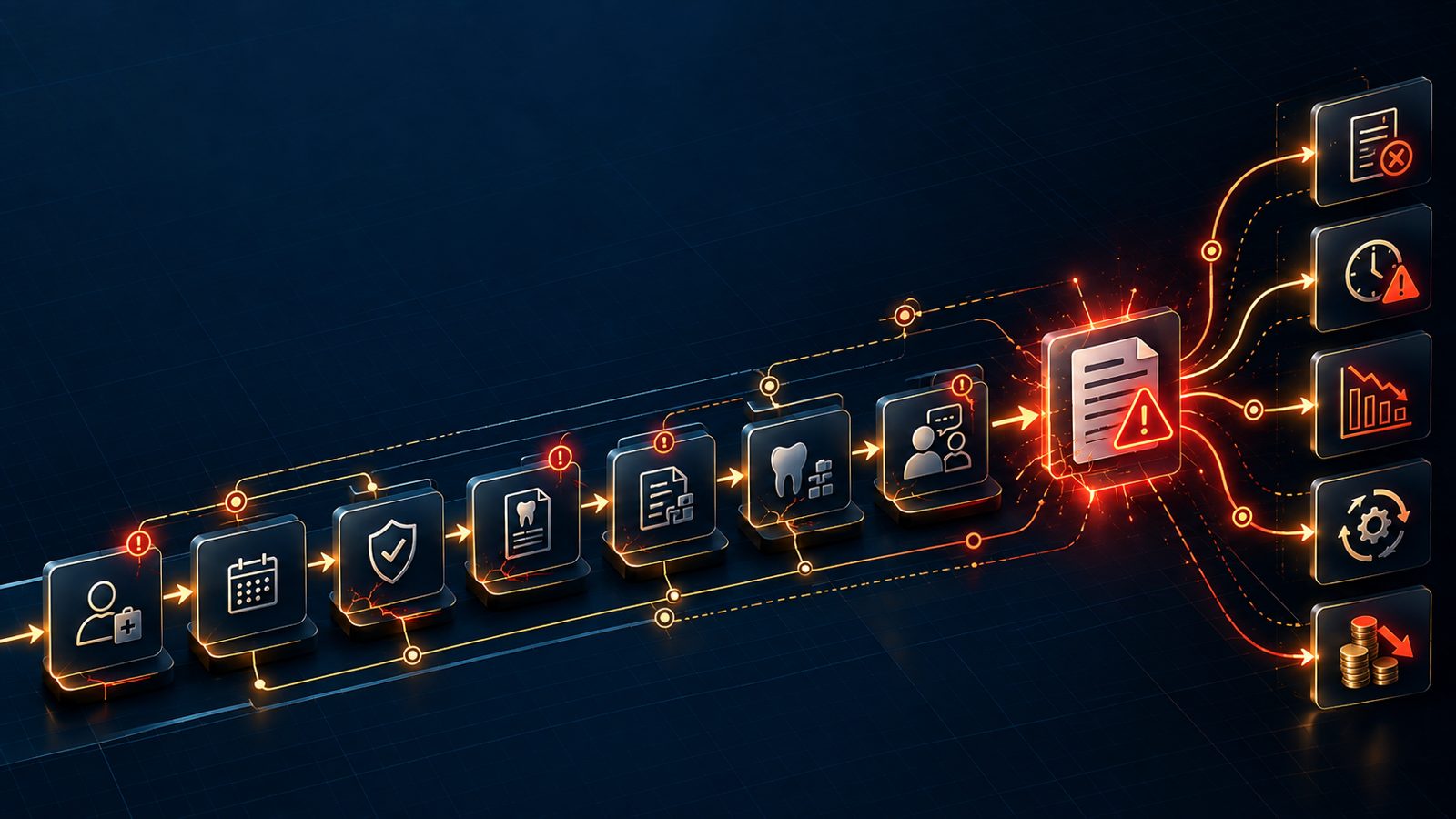
Why claims inherit problems created long before they reach the billing team
A claim is denied. The balance lands in Accounts Receivable. Someone asks Billing why it wasn’t paid.
That’s a fair question, but it may be the wrong starting point.
Billing can correct a rejection, follow up with a carrier, and appeal a denial. Billing cannot go back in time and verify a plan before treatment, correct a financial conversation that already happened, or create clinical findings that were never documented.
By the time the claim reaches Billing, the conditions for payment have largely been set.
Follow one claim backward Imagine a patient receives treatment and the insurance payment comes in lower than expected. The patient is surprised by the balance. The team now has to investigate, explain, and possibly adjust the account.
It looks like a payment posting problem. So work backward:
Submission: Was the claim accurate, complete, and sent with the necessary attachments?
Documentation: Does the clinical record support the treatment and code submitted?
Verification: Were the plan’s limitations, frequency rules, network status, and possible downgrades checked before treatment?
Intake: Was the correct patient, subscriber, and insurance information entered?
Financial policy: Did the team have a clear standard for estimates and patient responsibility?
The payment may have been posted correctly. The first preventable break might have happened when “active coverage” was treated as a complete benefit check. Or when verified information was saved in a document but never entered into the fields used to calculate the estimate.
Now Billing is managing the consequence of a decision made earlier.
The point is to find the first break If the same problem keeps happening, look at the process around the work.
Did the team have a clear standard? Did they know who owned the handoff? Could anyone tell whether the step was completed? When an error was found, did someone fix the process—or just that one account?
Correcting the account matters. Correcting the process keeps the next account from arriving with the same problem.
That is the difference between recovering revenue and protecting it.
What should an owner look at? Accounts Receivable tells you what has accumulated. It does not, by itself, tell you where the trouble began. To see problems sooner, look for changes closer to their source:
Demographic and subscriber rejections
Verification details missing from the practice management system
Claims waiting for clinical notes or attachments
Repeated denials for the same reason
More insurance discrepancies, write-offs, or patient balance disputes
Claims that were created but never submitted
You do not have to personally work every claim. You do need a way to see these patterns, know who is responsible for investigating them, and confirm that a correction actually happened.
Try this with one account Pick a recent denial, unexpected patient balance, or adjustment. Ask:
Where was the first point at which we had enough information to prevent this outcome?
Trace the account from financial policy and first patient contact through verification, documentation, submission, and payment review. Identify the first avoidable break. Then decide what would make that step more reliable next time.
Sometimes the answer is a clearer policy. Sometimes it is a required field, a documentation standard, or a report someone needs to review each week.
That is the work behind Revenue Protection Architecture™. Revenue does not suddenly fail when it reaches AR. AR is often where an earlier failure becomes visible.
Find the first break. Fix it there.
Want to see where your practice may be vulnerable before a balance reaches AR? Answer 12 questions in the free Revenue Readiness Check to find the first pillar that needs your attention. [https://mrbvivalv0.wixforms.com/f/7509617786398704760]
Michelle Repash
Creator of Revenue Protection Architecture™ · Founder, RepashGlobal
Back to all articlesThe Revenue Architecture Brief
New thinking, in your inbox.
Short, direct notes on where dental revenue actually breaks — and how to protect it. No spam, unsubscribe anytime.